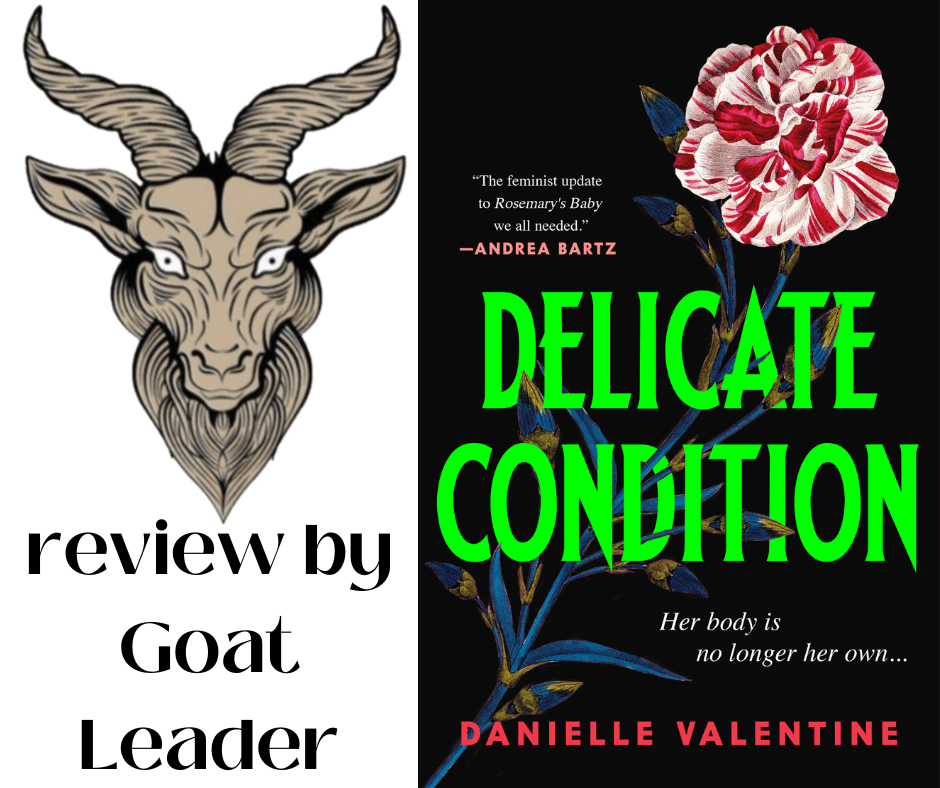
Anna Alcott is desperate to have a family. But as she tries to balance her increasingly public life as an indie actress with a gruelling IVF regime, she starts to suspect that someone is going to great lengths to make sure that never happens. Crucial medicines are lost. Appointments are moved without her knowledge. She’s sure she’s being followed. And when she finally does get pregnant, someone breaks into her house and steals the ultrasound photograph of her baby. But despite everything she’s gone through, not even her husband is willing to believe that someone is playing twisted games with her.
Then her doctors tell her she’s lost the baby. Despite her grief, Anna ignores the grave-faced men lecturing her – because she can still feel the baby moving, can see the toll it’s taking on her weakened body. Isolated in a remote snowbound town, Anna is sure that whoever has been following her is closing in on her and her unborn child. And as her symptoms become more terrifying, she can’t help but wonder what exactly is growing inside her… and why no-one will listen when she says that something is horribly wrong.
Disclaimer: I’m not only discussing the book itself in this review, but the reasons that I related to it so much. I’ll be going off on one a little bit about the medical mistreatment of women, and some of my own medical experiences. If these topics aren’t your jam, here’s a basic summary of my thoughts on Delicate Condition so you can stop reading after this paragraph….. “book good”.
Dark bleatings everyone! I’ve been on a recent hunt for pregnancy horror, and this is my most recent read of that ilk (please let me know if you have recommendations for more!). The older I’ve got, the more terrified of pregnancy I’ve become. I figured that reading horrific supernatural pregnancy tales would rid me of my anxiety about the comparatively normal pregnancy I hope to one day experience. I’ll keep you posted on whether or not this is a great idea…
We’re mostly in first person for this one, which I enjoy but I’m also difficult to please with this tense. Blame Kit Power. He’s exceptional when he writes in first person, which means I compare every other first person narrative to his work (I’m very sorry, I can’t help it, he’s one of my favourite writers!). Initially, it didn’t quite gel for me, but I was determined to continue on anyway, and once I’d adjusted, I very much was on board.
The reason I picked this up is because of the most recent season of American Horror Story, which is based on this book. We’ve only had the first half of the season so far and I really enjoyed it, so I wanted to read the book before the second half was released. I don’t know why… I can’t tell at this point if I’ve now ruined the show for myself, or enhanced my viewing experience. I guess it depends which way the show might take the story.
The story of Anna and her fertility issues, and medically miraculous pregnancy goes way beyond the issue of childbearing. I’d say that the pregnancy itself serves as the catalyst for what the story is really about and, to me at least, that’s the disproportionate medical neglect that women suffer. This is an issue that I care deeply about due to experiencing more than my share of medical issues (mostly from emergency surgeries and the subsequent consequences), and it’s recently been on my mind again because of Gemma Amor’s excellent novel, ‘Full Immersion’. That’s a little different in that it deals with mental health, but I’m just gonna go ahead and say it – regardless of whether you’re dealing with mental or physical health, if you’re a woman, you’re likely to find it harder to be taken seriously by both medical professionals and the people around you. Especially if you’re pregnant.
To clarify, I’m not up on a soapbox here saying that everyone is sexist and that doctors laugh at women in pain and revel in their misery. What I am saying is that once upon a time, not that long ago actually, the female specific diagnosis of ‘hysteria’ was a thing, and it basically applied to any woman that complained of any ailment. The treatment was to shut them away in isolation until they calmed down. Unfortunately, society inherits opinions, constructs, and mindsets, and what’s “normal” at one point filters down through the generations. Though we’re well past the time of locking women up in attics for having post-natal depression or complaining of pain that they were assumed to be imagining, we have unfortunately not yet shed the misogynistic idea that women can’t be trusted or taken totally seriously when discussing their own health. I’m not saying it’s always intentional, but I am saying that this is still a thing. I’ve experienced it numerous times. Once, quite alarmingly, I was complaining of a daily, excruciating pain, and every GP I saw told me I was paranoid because of all the abdominal surgery I’d just had. They said some “discomfort” was normal. I kept saying it wasn’t discomfort, it was a blinding, debilitating pain that put me on my ass every time I got out of bed. It didn’t occur to any of them that perhaps I had a serious medical complication, you know, on account of all that recent surgery. I ended up having another emergency surgery because of the pain I’d apparently imagined (which was a surgical complication… who knew? OH WAIT, I DID!).
And I fear it’s even worse sometimes for pregnant women. Millions of women have been bearing children for millions of years, having multiple pregnancies in many cases, and it’s such a normal (and expected) part of human life. I personally think that this, amongst other things, is a reason that pregnancy anxieties are so often either ignored, or chalked up to silly women and their silly baby hormones. Every woman I know that has been pregnant has at least one story of being dismissed when expressing a concern, especially when we’re talking about pain and discomfort. Some of the things that women can experience during pregnancy are horrific, but it’s so common that as a species we seem at best desensitised to it, and at worst, insensitive to the point of complete apathy or even anger towards a human – not, in fact, an incubator – who is suffering. I’ve seen videos of men who were allowed anaesthetic for tattoo sittings, but women are subjected to being absolutely slated for using pain relief while pushing a human out of their hoo-har.
Wait a minute… what am I talking about? Oh yeah, the book!
So, Anna is nearing 40 and so getting pregnant is now an issue for which she and her husband need medical assistance. Luckily for them, they’re in a financial position that allows them these options. Anna is an actor who appears to finally be getting her big break at the same time that they’re trying to conceive. A lot of this book deals with Anna trying to balance her work ambitions and priorities with her pregnancy, which already feels risky and frightening. I thought the author did a great job of showing Anna’s frustrations and concerns in contrast to how her doctor and husband were treating her. She’s expected to just be a shell for the baby, basically. She’s been working solidly for her whole life trying to get her career to lift off, and it finally is, but instead of being allowed to feel happy about that, she’s made to feel selfish and like a bad mother already for wanting to have both a baby and her career. No one around her seems to be trying to help her problem-solve the areas of her life that are now complicated by impending motherhood, she just keeps getting told at every turn that the baby is more important. It was so frustrating to read because Anna, of all people, knows the baby is more important – it’s the thing she wants most in the world. She’s just looking to her loved ones and doctors to help her navigate things so she doesn’t have to sacrifice literally everything else she has going, but they won’t because they don’t care. The moment she conceives, she ceases to be a person and is now just a vessel.
The other thing that made my blood boil was, as I related, the medical stuff. On numerous occasions, she is frightened and confused and though there are people who know what’s happening, she’s not being informed. Her husband, however, is the person the doctors tend to address, the person who’s opinion and consent they value. There’s a scene that was particularly infuriating to me because it happened to me – she’s freaking out and instead of listening to what she’s saying, they treat her like a hysterical child and without her consent – in fact, she’s explicitly telling them “no” – they administer a sedative. I understand the concept of such a thing (to an extent) if we’re dealing with someone who actually isn’t in control of their faculties and it is sincerely for a good reason. But Anna was just pregnant, for God’s sake.
Another mini story-time (and there’s a point to this, I promise): I had a big load of surgeries all in one go, and was obviously on quite a lot of morphine for a number of weeks. I don’t begrudge the morphine, I definitely needed it for the pain management. The problem with morphine is that it’s a deliciously effective opiate that not only helps with pain, but makes you quite pleasantly high, and it is extremely physically, chemically addictive. I was cut down from morphine to Tramadol, and was on it for a couple of months. This will sound so stupid, but I didn’t know it was addictive, nor did I actually understand what that meant. I’d never been addicted to anything before. Picked a hell of a drug to start on, didn’t I? I don’t begrudge the morphine, but I very much begrudge the fact that not a single doctor or nurse informed me that I would form an addiction, the process of coming off it, or the absolute sheer Hell of opiate withdrawal. We’re talking vomiting, profuse sweating, depression (if high becomes your new normal, it is extremely jarring when the thing causing your artificial joy is suddenly gone), insomnia, and the worst of it, for me, the horrendous physical discomfort. It’s hard to explain, but it’s the withdrawal symptom that lasts weeks and then recurs every now and then, you know, just to remind you that you’re an addict so you can feel nice and ashamed. It feels like every nerve ending in your body is mildly on fire and trying to escape through your pores. Bloody horrible it is. It took me a few months to come off it completely, and then a few more before I felt safe to be around co-codamols without losing my shit and wanting to munch them all. It’s an experience I wouldn’t wish upon my worst enemy. (And before I go on, I’d like to stress that there’s no need to worry about me in this regard now, all is well).
So you can imagine the absolute panic when I was rushed back into hospital for that second emergency surgery I mentioned earlier, knowing that when I woke up, I’d be on morphine. It wasn’t long enough since the first time, I had only just come off it altogether. The thought of having to do all that again and so soon after almost broke me. I expressed this to my surgeon, who assured me that I would not be given opiates without my consent. It was not advised to wake up from a major surgery without morphine, but it was my call. They promised not to give it to me unless I asked, and had someone on standby when I woke up just in case. I woke up from the surgery feeling quite pained but not unbearably so, and decided not to take the morphine.
A full day later, a nurse came in and asked what my pain level was. I told her quite bad, but ah well, what can ya do. She said “I’ll give you pain relief”, I said, “no thank you”, she insisted, I insisted no, I explained to her that I was technically an opiate addict because of last time and that I’d not long conquered it, and that I’d rather be in pain in the short term than go through those withdrawal shenanigans again. She actually rolled her eyes at me and said I was being difficult, that I couldn’t just not have pain relief after a major surgery. I said I was an adult and did not want the drugs, thank you very much. And then, and pardon my language here, that fucking bitch went ahead and fed it to me through a drip. I wasn’t aware for a minute because of being on a fluid drip already, and she wouldn’t answer me when I asked her what she was doing. She told me afterwards that I’d thank her later. The sheer panic, outrage, and devastation at having someone overrule my autonomy like that… honestly, I can’t even describe the mental carnage. If you’ve ever been in a similar position of vulnerability, I’m sure you can imagine the terror that engulfed me in not having a say about what was happening to my own body. Not just that, but I was overruled by a nurse who did the one thing I was absolutely terrified of having forced on me.
If you’re thinking, “I’m not sure I believe this, that’s a ridiculous story,” then I agree with you – it is ridiculous. And you wouldn’t be the first person to react like that to being told something as insane as a nurse forcing opiates on an addict refusing the drugs. It’s a bit Annie Wilkes, isn’t it? I cried about this incident to a close friend who’d also had lots of surgery, and he looked me dead in the eye and said, “sorry but there’s no way that happened, they can’t just do that.” Which, ironically, just goes further in proving my point about women not being taken seriously about their medical shit, and being treated differently to men.
Hang on.. what were we… oh yeah, the book!
The reason I’m bringing these life experiences is up is because this book unearthed those memories. Even though I’ve never been pregnant myself, the protagonist and her experiences were so goddamn relatable to me that even though I was getting progressively angry as I read, it was also weirdly comforting to connect to a character with whom I had so much insane stuff in common. Again, I felt this way reading Full Immersion, too. I truly think that Delicate Condition is a powerful book, and while there is possibly a little something supernatural afoot (or is there?!), at its core, it’s a sympathetic exploration of a pregnant woman being gaslight out of her freaking mind, and then being labelled the crazy one when, in fact, she’s the most logical person in the whole book. It’s also, for many reasons, truly horrifying.
It didn’t go where I thought it was going either, and that was a huge plus for me because I hate it when I correctly predict an ending. There are a lot of moving parts in this book and they all eventually slot so well together that the third act felt like a real triumph in set-up and pay-off.
I’d recommend this to… well, really, my hope is that all kinds of people will give it a shot. It might be triggering to people who’ve suffered fertility issues and losses, so proceed with caution if you’re in that boat. But for everyone else, I think there are probably loads of people like me that might find some sort of community in this book, as well as a good horror story. For people who can’t relate, I would hope that it will by an eye-opener. On first thought, it might feel like an exaggerated version of what so many people experience, but from where I’m sitting, it sounds about right to me.
Thanks for coming to my TED Talk. If you’d like to get your own copy or check out the author, there are links below for you:
 Happy Goat Horror
Leave a comment