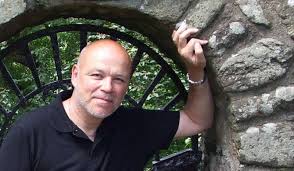
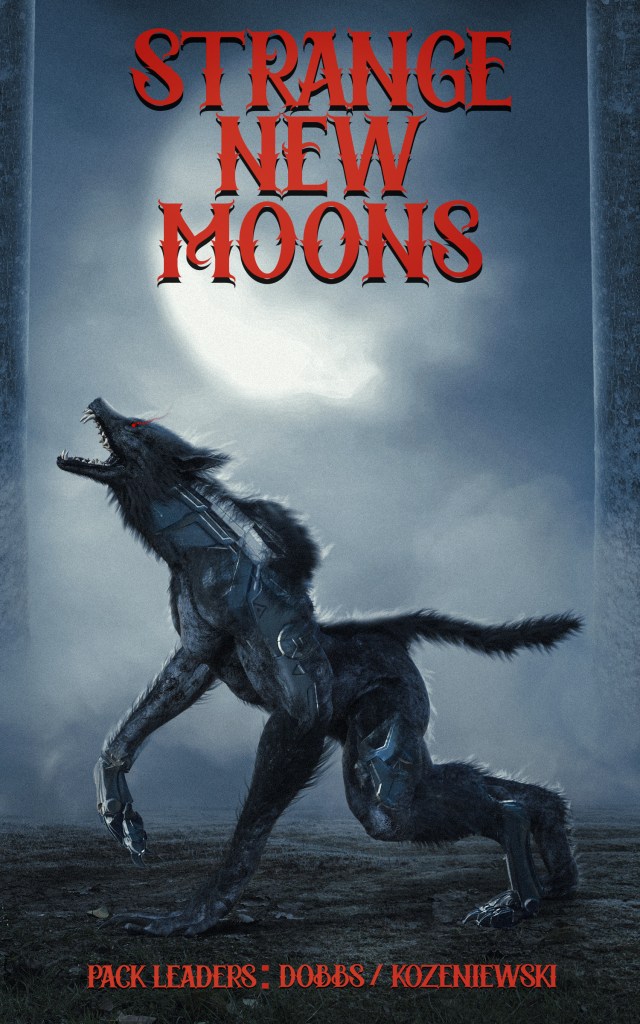
Dark bleatings, my awesome tribe! Simon Clark is the next author I’m featuring as part of my bid to get you all reading Strange New Moons, a werewolf anthology I poured my heart and metamorphic soul into, along with Stephen Kozeniewski.
To kick things off, a note from Simon about his story, Red in Tooth and Law:
“Although I have written a lot of horror novels, like BLOOD CRAZY and VAMPYRRHIC, and the Sci-Fi novel THE NIGHT OF THE TRIFFIDS, I haven’t penned many werewolf stories. In fact, I have only written two. These are ‘The Last Barnsley Werewolf’ and the story published in STRANGE NEW MOONS, namely ‘Red in Tooth and Law’. And, now I come to think of it, I wonder why I haven’t produced more werewolf stories because the werewolf is a fascinating monster to feature in a tale of horrific fiction. After all, don’t we all have something of the werewolf factor inside of us? Yes, normally we are civilized, polite people but there is always a rage trigger, isn’t there? There is always some ‘thing’ that will release our fury in a way that would be as terrifying to us as it will be to others. Okay, we won’t suddenly grow fur and sharp fangs, but we all know that there is a savage beast inside of us that will seize control of us if circumstances allow. That is truly scary.
Admittedly, there is little chance of us becoming a zombie, or a vampire, but we’ve all felt the sudden surge of bestial blood running hot in our veins. Becoming a werewolf puts canine features on a benevolent human face, which makes a werewolf story a piece of safe entertainment. But real humans always wear a human face no matter what terrible things they have done. I have given talks to serial-killers in prison. They have committed terrible acts of violence on people. They have murdered. They have fed on human flesh. However, I found the serial-killers to be pleasant and polite men who chatted to me in a friendly way. Their hands once dripped with the blood of their victims. But always – always – they have a human face. If only they had the snout and jaws of a wolf, then we could feel superior to them. We could insist we are not like them at all because they aren’t human. But the serial-killers are human. Just like us. Now that I’ve written my second werewolf story, thanks to those lovely people at French Press for inviting me to do so, I am tempted write more stories about those individuals who await the coming of the full moon with trepdidation – and maybe even delicious anticipation…
Simon, as I’m sure many of you will know, has been feeding us brilliant horror for decades, and I’m thrilled to have him here. So let’s get on with it!
Me: In terms of the scale of devastation, Red in Tooth and Law is definitely the biggest in the anthology. Did you know where you wanted to go for the ending when you started writing it?
Simon: No, I didn’t have that exact ending in mind, but, having said that, I suspect a lot of the story planning takes place in my subconscious. Also, I love those big apocalyptic stories, so I have a tendency to follow that path toward epic devastation.
What are the most overused and underused werewolf tropes, in your opinion?
We are so used to seeing the full moon transformation of human to werewolf in films, right from the early days of cinema, where the man or woman falls back into a chair as the full moon shines through the window, and then the fur appears on their face. The transformation scene is great cinema, of course, but it does mean we tend to be locked into the expectation that transformation from human to wolf-like creature is a vital part of every story. I guess that is part and parcel of a werewolf tale, just as if we were reading a story about a chef’s exploits in a kitchen, we would be locked into the expectation that a meal would be prepared then eaten. As for underused tropes, there must be scope for a writer to dream up a different kind of transformation, and to invent different consequences for the victim of lycanthropy. Afterall, unlike Dracula, who is synonymous with vampires, I don’t think we have had single character that symbolises the werewolf.
I’ve never thought about that before but you’re right – when I think ‘werewolf’, there isn’t a particular staple character that comes to mind, just a generic beast! I loved that your story introduces two types of werewolves (the Ferals are scary!). What inspired this choice?
I was drawn to the notion that there would be an entire species of werewolves who quietly managed their transformation and stayed at home and didn’t run amok. Of course, there had to be another version, the Ferals, who would do the opposite and become berserk hunters, rampaging through towns and cities.
It feels like your main character is straddling both worlds. What about his personality and convictions were you most hoping to establish to the reader?
That’s a good question. I’m fascinated by liminal places, like beaches that form intriguing boundaries between the world of dry land and the realm of the ocean. I’m also fascinated by liminal characters that have the ability to straddle two worlds – or perhaps even be doomed not to belong to one world or the other. In a very fundamental way, we all experience that as children. When we are ten years old, we are definitely children, and we occupy the childhood world. But what happens when we are thirteen or fourteen? We begin to move into the world of adulthood. However, we are not fully adults, nor are we fully children anymore. We straddle those two worlds somewhat awkwardly. We don’t feel like we are fully adult. Neither are we children anymore. It is difficult to make that journey from childhood to adulthood and sometimes feels alarming and difficult for the child. Perhaps, I am drawing on that time of uncertainty and projecting it onto the main character in Red in Tooth and Law. They forever feel like an outsider and can’t belong to any one community, yet the main character does have a personal conviction that he must do good in the world – of course, as we all know, the road to hell is paved with good intentions.

Any thoughts of expanding this story into a novel (she asks hopefully)?
The seed has been planted. Already, I have some ideas for a werewolf story with a wicked twist or two.
Yay – that’s music to my ears! As an established author, what would you say is the best part of being a writer?
Without a shadow of doubt, it is writing the stories, inventing plots, plunging characters into exciting situations. A highly enjoyable part of being a writer is meeting other writers and readers and having the opportunity to travel. Being a writer has taken me to festivals and conventions in places like Salt Lake City, Tallin and many cities in Britain.
I love those conventions. You’ve mixed other genres into your horror fiction quite a bit over the years. Which genre, for you, is the best fit when merged with horror? (Sci-fi, dystopian, fantasy, etc.)
That’s a good question. Horror can be woven into many genres such as crime and Sc-Fi. For me, I either writer horror, or it’s horror merged with Sci-Fi, such as in my novel ‘The Night of the Triffids’. I guess if I wrote in any genre horror would come creeping into it, come what may.
Let’s go back to conventions for a second, because I’m obsessed with them. What is the main benefit of in-person reader/writer conventions for you?
I really do enjoy going to conventions to socialize with readers, writers, editor and artists. We get a valuable chance to talk shop, let off steam and recharge our batteries. Sometimes I have been offered work at conventions, such as an editor asking me, out of the blue, to edit an anthology. Once a French publisher won a novel of mine in a convention raffle. They’d never heard of me before but when they read the book they asked me if they could publish an edition in French. Of course, I said “yes”!
Meeting other creative folk is my favourite part too! How does the process of co-writing compare to writing on your own?
Before I did any co-writing I imagined it would be difficult. However, it’s always gone amazingly well. Often, the co-writer and myself, will knock ideas back and forth during brainstorming sessions, then one of us will begin writing that particular scene. Of course, when I’m solo writing I sit and do all the brainstorming by myself.
Do you often have story ideas “banked” so that when you finish one book, you’re about ready to start on the next one?
Usually, I am jotting ideas down for a film script, for example, as I’m working on a book. Generally, I have two or three ideas in the “bank” at any one time.

Okay, sorry about this Simon but it’s time for the real hardball questions – the people are gonna want to know these answers.
The zombies have turned up and life as we know it is over. You must pick two people from this list to stand by you for the rest of your days. Who will it be?
Winnie the Pooh
Mickey Mouse
R2-D2
The Queen of Hearts
Mrs Potato Head
R2-D2 and Winnie the Pooh – R2-D2 for protection. Winnie the Pooh because I think I can run faster than him, so the zombies get him instead of me.
Simon…that is savage, I’m shocked! Alright, next one. You’re the organiser of an underground fight club and you’re deciding the match ups. Who’s fighting who (and who are you putting your money on)?
Ellen Ripley
Venus Williams
Matilda
Pennywise
Prince Harry
The Cowardly Lion
Pennywise and the Cowardly Lion – what a match! I put my money on the Cowardly Lion because every story, and every fight club match, must have an unexpected twist.
You’re in charge of casting for the remake of ‘The X Files’ – who are you casting in the main roles?
Boris Karloff (Mulder) and Sarah Lancashire (Scully) – they will make a lovely odd couple.
Note to readers: I think this is the first time I have sincerely been rendered speechless by an interview question answer. Boris Karloff lol.
Finally, tell readers what they can expect if they pick up your books.
In the main, my novels are horror of quite an intense variety, though I prefer that horror to develop from the situations rather than just pile in lots of slasher gore. My novel series Blood Crazy reveals what happens when everyone over the age of nineteen undergoes a profound psychological change and begin attacking everyone below the age of nineteen. As you can imagine, several of my novels deal with the collapse of civilization. For me, though, an apocalyptic tale isn’t really about the end of society, it’s about the start of something new, where new friendships are formed, and where people are forced to confront their fears and become, in their own way, heroic in order to survive.
Thank you Simon, for participating in this interview!
If you’re interested in checking out Simon’s work, you can find him at:
Simon’s X @hotelmidnight
Simon’s Bluesky @simonclarkwriting.bsky.social
And, of course, don’t forget to grab your copy of STRANGE NEW MOONS!
The Blood Crazy series novels and The Protos Experiment novel of the film are available from: https://www.dv-publishing.com/
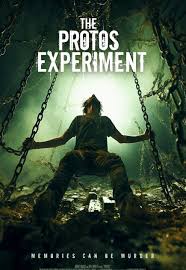
And one last thing before we shoot off – a film based on Simon’s ‘The Protos Experiment’ wants to be in your eyeballs! Links to the book, my book review, and the movie trailer below:
MY REVIEW OF ‘THE PROTOS EXPERIMENT’
THE MOVIE TRAILER (click the image!)
Bleeeeeat!
 Happy Goat Horror
Leave a comment