When beloved cartoon characters come crawling out of her TV, army recruiter Gabriella Harman expects a zany romp instead of the hellish nightmare that follows.
One night, haunted by her memories of Iraq, Gabriella downs a stomachful of pills and booze. When her favorite cartoon characters, the Kooky Toons, start crawling out of the TV, she assumes she is hallucinating.
But soon Gabriella finds herself locked in a battle of wits and wills with Herman Hyrax, the world-famous, wise-cracking mascot of the Kooky Korporation. Herman is more than just a stinker, though. He may be a monster, a demon, a god, or something entirely more unwholesome.
Is Gabriella’s descent into a world of cartoonish violence and psychological torment real? Or has she simply gone…
LOONEY!?
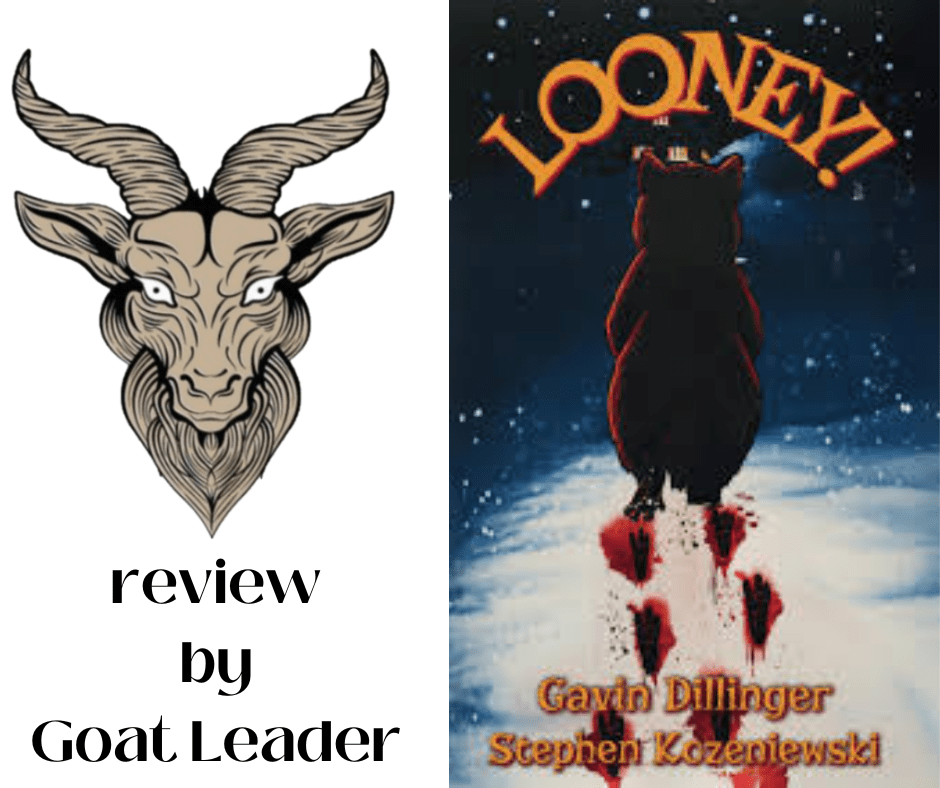
Dark bleatings, my cartoon loving tribe. Is this a real book, or a fever dream I had after passing out in front of a Bugs Bunny cartoon? Even now, I’m not completely sure.
Comedic genius Gavin Dillinger and veteran (in both the military and author sense) Stephen Kozeniewski joined forces to give us a story that straddles complex PTSD, all out war, and bloody violence, and a plot that is, quite frankly, absolute lunacy.
Plagued by insomnia and mental health struggles (handled with subtlety and respectful realism), Gabriella puts on her favourite comfort show – a classic cartoon – and takes a few too many sleeping tablets and washes them down with too much alcohol, desperate to just fall asleep for a few hours. When she cracks her eyes open again, the cartoon is…not right. An episode she’s seen a thousand times and is watching on a VHS tape suddenly has differences. Characters aren’t where they’re supposed to be and lines of dialogue have changed. The next thing she knows, cartoon characters Arty and Silly are out of the screen and in the real world, begging her for the sweet relief of death. The head of the cartoon gang is a terrible violent tyrant, you see.
What follows through the rest of the book can only be described as an extremely violent but hilarious battle for power and allegiances. Imagine if someone…like Gavin or Stephen, for example, decided to merge the whimsy of classic kids’ cartoons with those sadistic little woodland critters from South Park, with an added sprinkling of Full Metal Jacket.
We get cartoons operating with typical cartoonish function (complete with sound effects, which was possibly the element that cracked me up the most) in the real world, and human Gabriella trying to figure out the mechanics of being human in the cartoon world. We also get comedy (obviously), action, social and political commentary, and oh look, what’s this? Lovecraftian, cosmic horror?! What’s that doing in there?!
Structurally, I really like how the book was written. Most of the story is told through classic third person narration, but it’s spliced with script segments of the cartoon (which are relevant, don’t skip over them, particularly because of the production notes scribble in), and also these little biographical segments about the creator of the cartoons in question.

A criticism I was initially going to make here was about the B plot. The best narratives always have a good A plot (in this case, cartoons are at large in the real world and Gabriella is thrust into the obligation of battling a maniacal psychopath) and a strong B plot, which normally comes in the form of internal struggle and some sort of progression in the main character. The surface story is about rampant cartoons, but what’s beneath that? What’s this story really about? The B plot is always the most important part of a story to get right, for me as a reader. I initially thought that the balance was a bit off – a lot has gone into the A plot, but I worried that the B plot was a bit lacking. Gabriella is battling inner strife, but besides the opening and then more discussion in the last 10% of the story, it doesn’t seem present.
However, upon reflection, I think what the authors did here was show us Gabriella’s turmoil through parallels with the cartoon’s creator, Jim Khuki, and also through the antagonist, Herman. The script and biography sections indicate Jim’s struggle with his own creation (an extension or side of himself, you might say), and Herman never stops dreaming of his glory days and comparing them (with an inability to properly accept change) to his current situation. He’s stuck in the past. Gabriella has more in common with both of these characters than you might think, if you scratch beneath the surface a little.
Overall, I was highly amused, and I think if you like to have a laugh with your horror, this might be for you. If you’d like to check out the book or the authors, I’ve popped some links below for you:
Bleeeeeat!
 Happy Goat Horror
Leave a comment